 |



 |
 |
 |
|
|
S.P. Publishing Group Co., Ltd.
11/1 Soi 3 Bamrungburi Rd., T. Prasingh,
A. Muang., Chiang Mai 50200
Tel. 053 - 814 455-6 Fax. 053 - 814 457
E-mail: guidelin@loxinfo.co.th
|
|
 |
|
 |
CHIANG MAI’S CITY PILLAR CEREMONY
Getting a Little Below
the Surface ‘Realities’
Text : John Cadet
Images : SP
You’ve ‘done’ the Northern capital and seen its attractions, right? Got the T-shirt and are ready to tell the story when you get back home.
That obligatory visit to Wat Phratat on its hill-top overlooking the city, for example: such a colourful and spacious temple, and such a glorious view below. A trek into the surrounding country, perhaps visiting the village of the long-necked women. Wow! Quite a step out of the quotidian, no question about that. And getting around town itself – browsing trendy Nimmanaheminda Road, let’s say; can’t complain about the shopping there, or that it’s difficult finding a fashionable bauble or two to take back home. And the Walking Streets besides, for their tricks, treats, curiosities, right out on the pavements – everything from didgeridoos to ethnic versions of Dunkin Donuts and lots in between. A night at one of the Thai boxing stadiums could well be on your itinerary too. At which you might find yourself asking occasionally, “Where did that blood come from?”, because like many sporting activities and not only in Thailand, not everything in the fisti-footicuffs business is fully in view. And if you hit the town for one of the famous festivals – the Thai New Year at Songkran, the Festival of Lights at Loy Krathong in the autumn – you’ll see it spectacularly decked out for the occasion. Which is not to mention the creature comforts provided here by hotels, guest houses, restaurants, pubs, bars, spas and beauticians.
But more than anything else though, what you’re going to take away with you (if you do get away, and quite a lot of us don’t), is the easy-going atmosphere of the North and its people. Where else in the world do you have the feeling the moment you arrive that you’re welcome wherever you go, and that however exotic the surroundings, you’ve never been more at home? Yes, there’s the language impediment – their English and your Thai falling short of the perfect communicative medium, maybe. But what does that matter when smiles are universal, and graciousness is so unfailingly current? Mind, an unkind sociologist (farang, of course), complains that in their intercourse between themselves and with others the Thai display a ‘deep-seated superficiality’. To which you might of course retort that where the surface is so impeccable, who cares about depth?
But at the end of this month and the beginning of June you’ll have a chance to see that beneath the beauty and multi-faceted modern surface of Chiang Mai, there’s remarkable – no, no! That’s well short of adequate – mind-boggling evidence of the depth and antiquity of Thai culture. And while that culture covers the whole of the kingdom, it’s only here in Chiang Mai you find evidence of just how deeply it’s rooted.
And how are you going to come by that evidence, you’re asking.
Well, simply. Just truck on down to Wat Chedi Luang, one of the city’s biggest and most important temples, any time between 17th and 24th May. And what you’ll see along the road either side of the entrance of the temple and inside its main courtyard, will be stalls set up for the occasion, giving the impression of a very popular fair in progress, and offering too many goodies, most of them comestibles, to detail here. And impressively towering over the temple itself and much of the surrounding district is the great stupa a major earthquake severely damaged some centuries back, which has recently been repaired.
SAO INTHAKHIN PILLAR – Wat Chedi Luang
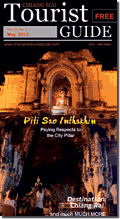
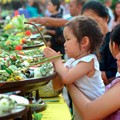
But since you’ve come at the time of the annual celebration of one of the city’s most important festivals, the Puja Inthakhin, or Piti Sao Inthakhin – Paying Respects to the City Pillar - outside the temple and in the main compound itself isn’t where the real action’s taking place. Just beyond the entrance, to the left, is an unremarkable little building, with a brick pillar surmounted by a Buddha image inside. This pillar is the Sao Inthakhin, and access to it is for monks and other males only. Outside, women can and do kneel to make their offering of flowers, candles and incense sticks, and the visitors of both sexes throughout the festival come from all over the North in their thousands. What they are doing is propitiating the city’s protective spirit and ensuring that the monsoon rains fall during the appointed time, so that the year ahead will be one of fertility and prosperity.
That in itself is not exceptional. Most towns of any age in Thailand have their lak muang, as the central pillar is known. The one in Bangkok is especially respected, and ceremonies are held in front of it throughout much of the year. What distinguishes the Chiang Mai pillar is the richness of the cultural records and legends attached to it, as well as the fact that its tutelary spirit is sky- rather than earth-located: that’s to say, is Indra, the Buddhist King of the Gods… and we’ll come to that intriguing anomaly shortly.
So what do we know about this city pillar?
According to one of Chiang Mai’s quasi-historical chronicles, the Dumnarn Suwanna Khamdaeng, back in the remote past, the Thai inhabitants of the region pleased Indra by faithfully following the Buddhist precepts. He rewarded them by establishing mines of gold, silver and precious stones in their territory, but while the city prospered, it also aroused the envy and acquisitiveness of other cities and princes around it. Alarmed, the citizens consulted a local rsi, or hermit, who advised them to turn again to Indra, and he sent them the Inthakhin pillar along with instructions as to how to maintain its protective efficiency. For a while, the citizens followed the practices the King of the Gods had prescribed, but when they became less observant, Indra was offended, removing the pillar and putting them back in danger. Having promised to mend their ways, the citizens of Noppaburi – as the city was named in those days - were given a second Inthakhin, and the Dumnarn devotes several pages to describing how it was constructed and what ceremonies devotees were to conduct throughout the year. Most significantly, giant dishes with representations of the various peoples of the region and its paired animals were buried under the pillar, and the rituals listed in the Dumnarn are largely those we see during the current ceremonies.
Not surprisingly, this being largely a Buddhist country, and the locus of the ceremonies a Buddhist temple, these ceremonious have their Buddhist gloss. As noted, a Buddha image surmounts the pillar, monks perform many of the rituals associated with it, and another image, the phra fon saen hah: ‘The Buddha of One Hundred Thousand Showers’, is conducted in procession through the town, with the object of stimulating the monsoon rains that usually begin at this time.
This procession, incidentally, is well worth viewing, both at Wat Chedi Luang when it gets under way, and during its passage through the city. The flags, colourful costumes, decorated chariots - drawn and attended by ‘soldiers’, school children and city officials - and especially the nail-dancing so gracefully performed at various locations, make it a memorable occasion. There’s no shortage either of lighter entertainment and commercial activities. The festivities inside the Wat Chedi Luang compound include a fair, with a stage set up for local dramatic performances and as already mentioned, there’s no need to go hungry or leave empty-handed, a multitude of stalls set up inside and spilling out along the road outside, offering souvenirs and tid-bits, some of which you might be able to recognise, if not name.
But let’s return to that point mentioned earlier – what was it? – about the depth of Thai culture under its allegedly superficial charm that this ceremony highlights. When King Mengrai founded Chiang Mai some 700 years ago, he’s reported to have found the remains of an earlier city on the site he selected: one item of which was a lak muang. Now the predecessors of the Thai in what is now the Northern capital were the Lua people, who sacrificed human beings by burying them under their own newly-erected fertility pillars. They later claimed to have substituted animal sacrifice for the human variety, and of course, since the taking of life is anathema to Buddhists human sacrifice was discontinued (though not everywhere) a long time ago. Nevertheless, animal sacrifice to propitiate the protective spirits of Chiang Mai still takes place – out in the forest, to be sure, but not without Buddhist association – as you will see if you’re adventurous enough to attend the piti bu sae ya sae ceremony that also takes place at this time of year. So you might think this offers a clue to the significance of the figures of humans and paired animals in the giant dishes said to be buried under the Sao Inthakhin. Symbolic, of course, but a firm link with that non-Buddhist practice of the past.
But where that depth of culture referred to above is concerned, there’s another feature of the history of the Sao Inthakhin and its ceremonies that’s especially intriguing, and takes us even deeper – right down to the Palaeolithic, you might think. Jao Mengrai is described in the Dumnarn as having originally set up his lak muang in the compound of a temple at the very centre of his new city. Its name was Wat Sadue Muang, which translates as ‘the Temple of the City Navel’. But you might suppose – the phallic nature of the Sky God’s gift of fertility nowhere acknowledged in the Dumnarn or anywhere else – that a touch of euphemism has also crept in here: and that navel might better be written as ‘navel’. The Dumnarn appears to support this supposition, since it says that at some point after its establishment at Wat Sadue Muang, the Sao Inthakhin was relocated to Wat Chedi Luang, and the official responsible for the move didn’t long survive it… the implication clearly being that the powerful spirits concerned weren’t best please by his action.
And if you accept that the Inthakhin is indisputably an Ouranean/sky fertility symbol, and that the ‘navel’ could well be its earth-located counterpart, you can hardly blame them.
There you have it, at all events: the modernity, charm and convenience you find all round you visiting Chiang Mai, but also just the most delicate brush with and reference to the proto-historic basis that culture rests on, if you look in on the Inthakhin Festival.
As I certainly recommend you to do.
 Text and Images © J.M. Cadet 2012 Text and Images © J.M. Cadet 2012
(The writer lives in Chiang Mai and his books - The Ramakien: the Thai Epic among them - are available at major book shops).
|






























![[ Yahoo! News Search ]](http://us.yimg.com/i/yahootogo/ytg_news.gif)
![[ Yahoo! Weather ]](http://us.yimg.com/i/yahootogo/ytg_weather.gif)